New From Here
We Dream A World

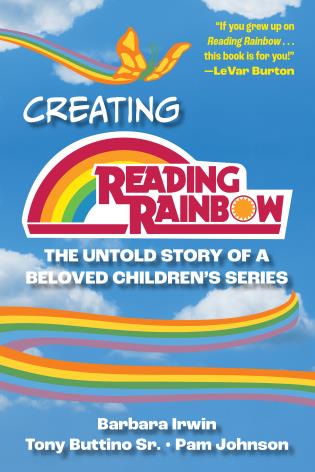
Creating Reading Rainbow: The Untold Story of a Beloved Children’s Series

Reading Rainbow is one of the most successful PBS children’s series in television history, earning numerous national and international awards including 26 Emmys and a Peabody Award. But perhaps more important than anything else, Reading Rainbow helped generations of children cultivate a love for books.

Reading Rainbow is very much a story of humble beginnings and enormous perseverance. Over five summers, Tony Buttino Sr. and his colleagues at WNED-TV, the public television station in Buffalo, New York, worked in collaboration with educators and librarians to experiment with summer reading programs. But after trialing these programs, the WNED team realized there was a big need for a new children’s literacy series and believed they could create a new show with local and national collaborators and friends. After fits and starts, and enough twists and turns to fill a children’s book, Reading Rainbow premiered in the summer of 1983 and captured the attention of 6.5 million young viewers.

Creating Reading Rainbow explores the many intriguing and homespun stories that, when woven together, reveal how this groundbreaking and iconic television series came to be. What led to the series being called “Reading Rainbow”? How did the road to Reading Rainbow wind its way through Mister Rogers’ Neighborhood? How did a public television station in Buffalo spearhead a movement in education and spark the passion for reading in millions of children? And, what does lasagna have to do with it?
More Non-Juvenile Books

  • How to Know a Person by David Brooks
    High Conflict: Why We Get Trapped and How We Get Out by Amanda Ripley When we are baffled by the insanity of the “other side”—in our politics, at work, or at home—it’s because we aren’t seeing how the conflict itself has taken over.That’s what “high conflict” does. It’s the invisible hand of our time. And it’s different from the useful friction of healthy conflict. That’s good conflict, and it’s a necessary force that pushes us to be better people.High conflict, by contrast, is what happens when discord distills into a good-versus-evil kind of feud, the kind with an us and a them. In this state, the normal rules of engagement no longer apply. The brain behaves differently. We feel increasingly certain of our own superiority and, at the same time, more and more mystified by the other side.New York Times bestselling author and award-winning journalist Amanda Ripley investigates how good people get captured by high conflict—and how they break free.
  • Housewife by Lisa Selin Davis challenges the outdated notion of the “breadwinner vs. homemaker” divide, arguing that women have been misled about the nature of family dynamics and motherhood. Through historical examples and cultural analysis, Davis advocates for a shift towards interdependence as the true American ideal, calling on all individuals to pursue liberation and the power to choose their own paths.
  • How to Know a Person by David Brooks
    How to Know a Person by David Brooks emphasizes the essential skill of deeply seeing others and making them feel valued and understood. By exploring questions about attention and conversation, Brooks offers insights from psychology, neuroscience, and various disciplines to foster connection in a fragmented society. This book serves as a guide for anyone seeking meaningful relationships and the joy that comes from truly understanding one another.
  • “A magnificent, compulsively readable thriller . . . Rice begins where Bram Stoker and the Hollywood versions leave off and penetrates directly to the true fascination of the myth—the education of the vampire.”—Chicago Tribune