The Cemetery of Untold Stories by Julia AlvarezThe Cemetery of Untold Stories
Isn't Her Grace Amazing! The Women who Changed Gospel Music

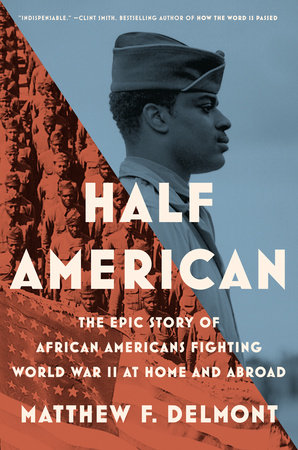
Half American: The Epic Story of African Americans Fighting World War II at Home and Abroad

More than one million Black soldiers served in World War II. Black troops were at Normandy, Iwo Jima, and the Battle of the Bulge, serving in segregated units while waging a dual battle against inequality in the very country for which they were laying down their lives. The stories of these Black veterans have long been ignored, cast aside in favor of the myth of the “Good War” fought by the “Greatest Generation.” And yet without their sacrifices, the United States could not have won the war.

Half American is World War II history as you’ve likely never read it before. In these pages are stories of Black military heroes and civil rights icons such as Benjamin O. Davis Jr., the leader of the legendary Tuskegee Airmen, who fought to open the Air Force to Black pilots; Thurgood Marshall, the chief lawyer for the NAACP, who investigated and publicized violence against Black troops and veterans; poet Langston Hughes, who worked as a war correspondent for the Black press; Ella Baker, the civil rights leader who advocated on the home front for Black soldiers, veterans, and their families; and James G. Thompson, the twenty-six-year-old whose letter to a newspaper laying bare the hypocrisy of fighting against fascism abroad when racism still reigned at home set in motion the Double Victory campaign. Their bravery and patriotism in the face of unfathomable racism is both inspiring and galvanizing. An essential and meticulously researched retelling of the war, Half American honors the men and women who dared to fight not just for democracy abroad but for their dreams of a freer and more equal America.
SEE LESS
More Non-Juvenile Books

  • How to Know a Person by David Brooks
    High Conflict: Why We Get Trapped and How We Get Out by Amanda Ripley When we are baffled by the insanity of the “other side”—in our politics, at work, or at home—it’s because we aren’t seeing how the conflict itself has taken over.That’s what “high conflict” does. It’s the invisible hand of our time. And it’s different from the useful friction of healthy conflict. That’s good conflict, and it’s a necessary force that pushes us to be better people.High conflict, by contrast, is what happens when discord distills into a good-versus-evil kind of feud, the kind with an us and a them. In this state, the normal rules of engagement no longer apply. The brain behaves differently. We feel increasingly certain of our own superiority and, at the same time, more and more mystified by the other side.New York Times bestselling author and award-winning journalist Amanda Ripley investigates how good people get captured by high conflict—and how they break free.
  • Housewife by Lisa Selin Davis challenges the outdated notion of the “breadwinner vs. homemaker” divide, arguing that women have been misled about the nature of family dynamics and motherhood. Through historical examples and cultural analysis, Davis advocates for a shift towards interdependence as the true American ideal, calling on all individuals to pursue liberation and the power to choose their own paths.
  • How to Know a Person by David Brooks
    How to Know a Person by David Brooks emphasizes the essential skill of deeply seeing others and making them feel valued and understood. By exploring questions about attention and conversation, Brooks offers insights from psychology, neuroscience, and various disciplines to foster connection in a fragmented society. This book serves as a guide for anyone seeking meaningful relationships and the joy that comes from truly understanding one another.
  • “A magnificent, compulsively readable thriller . . . Rice begins where Bram Stoker and the Hollywood versions leave off and penetrates directly to the true fascination of the myth—the education of the vampire.”—Chicago Tribune