
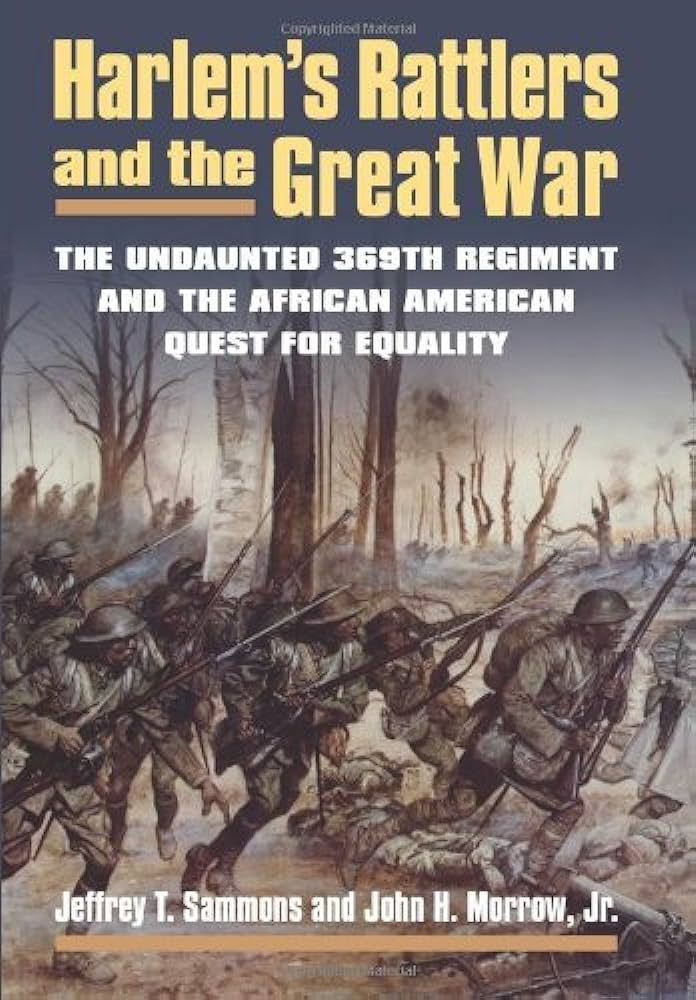
Harlem’s Rattlers and the Great War
When on May 15, 1918 a French lieutenant warned Henry Johnson of the 369th to move back because of a possible enemy raid, Johnson reportedly replied: “I’m an American, and I never retreat.” The story, even if apocryphal, captures the mythic status of the Harlem Rattlers, the African-American combat unit that grew out of the 15th New York National Guard, who were said to have never lost a man to capture or a foot of ground that had been taken. It also, in its insistence on American identity, points to a truth at the heart of this book—more than fighting to make the world safe for democracy, the black men of the 369th fought to convince America to live up to its democratic promise. It is this aspect of the storied regiment’s history—its place within the larger movement of African Americans for full citizenship in the face of virulent racism—that Harlem’s Rattlers and the Great War brings to the fore.
With sweeping vision, historical precision, and unparalleled research, this book will stand as the definitive study of the 369th. Though discussed in numerous histories and featured in popular culture (most famously the film Stormy Weather and the novel Jazz), the 369th has become more a matter of mythology than grounded, factually accurate history—a situation that authors Jeffrey T. Sammons and John H. Morrow, Jr. set out to right. Their book—which eschews the regiment’s famous nickname, the “Harlem Hellfighters,” a name never embraced by the unit itself—tells the full story of the self-proclaimed Harlem Rattlers. Combining the “fighting focus” of military history with the insights of social commentary, Harlem’s Rattlers and the Great War reveals the centrality of military service and war to the quest for equality as it details the origins, evolution, combat exploits, and postwar struggles of the 369th.