The Cemetery of Untold Stories by Julia AlvarezThe Cemetery of Untold Stories
Isn't Her Grace Amazing! The Women who Changed Gospel Music

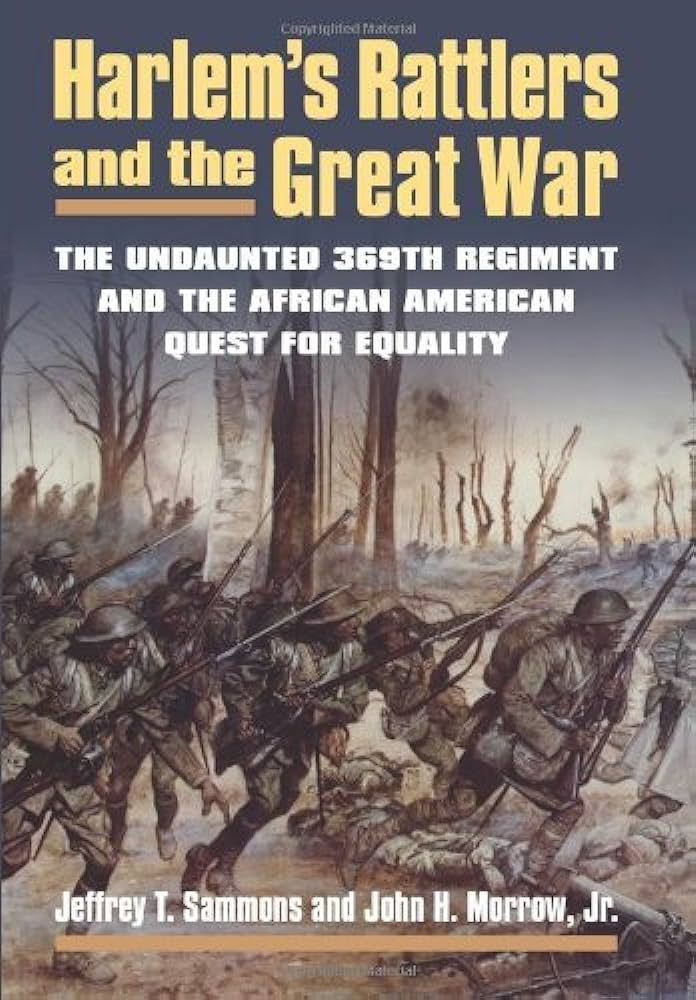
Harlem’s Rattlers and the Great War

When on May 15, 1918 a French lieutenant warned Henry Johnson of the 369th to move back because of a possible enemy raid, Johnson reportedly replied: “I’m an American, and I never retreat.” The story, even if apocryphal, captures the mythic status of the Harlem Rattlers, the African-American combat unit that grew out of the 15th New York National Guard, who were said to have never lost a man to capture or a foot of ground that had been taken. It also, in its insistence on American identity, points to a truth at the heart of this book—more than fighting to make the world safe for democracy, the black men of the 369th fought to convince America to live up to its democratic promise. It is this aspect of the storied regiment’s history—its place within the larger movement of African Americans for full citizenship in the face of virulent racism—that Harlem’s Rattlers and the Great War brings to the fore.

With sweeping vision, historical precision, and unparalleled research, this book will stand as the definitive study of the 369th. Though discussed in numerous histories and featured in popular culture (most famously the film Stormy Weather and the novel Jazz), the 369th has become more a matter of mythology than grounded, factually accurate history—a situation that authors Jeffrey T. Sammons and John H. Morrow, Jr. set out to right. Their book—which eschews the regiment’s famous nickname, the “Harlem Hellfighters,” a name never embraced by the unit itself—tells the full story of the self-proclaimed Harlem Rattlers. Combining the “fighting focus” of military history with the insights of social commentary, Harlem’s Rattlers and the Great War reveals the centrality of military service and war to the quest for equality as it details the origins, evolution, combat exploits, and postwar struggles of the 369th.
More Adult, Non-Juvenile Books

  • How to Know a Person by David Brooks
    High Conflict: Why We Get Trapped and How We Get Out by Amanda Ripley When we are baffled by the insanity of the “other side”—in our politics, at work, or at home—it’s because we aren’t seeing how the conflict itself has taken over.That’s what “high conflict” does. It’s the invisible hand of our time. And it’s different from the useful friction of healthy conflict. That’s good conflict, and it’s a necessary force that pushes us to be better people.High conflict, by contrast, is what happens when discord distills into a good-versus-evil kind of feud, the kind with an us and a them. In this state, the normal rules of engagement no longer apply. The brain behaves differently. We feel increasingly certain of our own superiority and, at the same time, more and more mystified by the other side.New York Times bestselling author and award-winning journalist Amanda Ripley investigates how good people get captured by high conflict—and how they break free.
  • Housewife by Lisa Selin Davis challenges the outdated notion of the “breadwinner vs. homemaker” divide, arguing that women have been misled about the nature of family dynamics and motherhood. Through historical examples and cultural analysis, Davis advocates for a shift towards interdependence as the true American ideal, calling on all individuals to pursue liberation and the power to choose their own paths.
  • How to Know a Person by David Brooks
    How to Know a Person by David Brooks emphasizes the essential skill of deeply seeing others and making them feel valued and understood. By exploring questions about attention and conversation, Brooks offers insights from psychology, neuroscience, and various disciplines to foster connection in a fragmented society. This book serves as a guide for anyone seeking meaningful relationships and the joy that comes from truly understanding one another.
  • “A magnificent, compulsively readable thriller . . . Rice begins where Bram Stoker and the Hollywood versions leave off and penetrates directly to the true fascination of the myth—the education of the vampire.”—Chicago Tribune