Into the Wild
The Call of the Wild

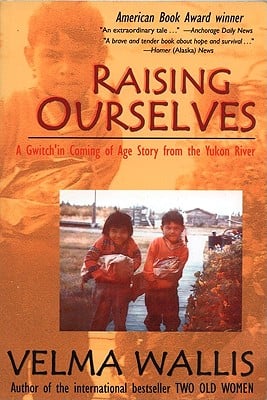
Raising Ourselves

Velma Wallis shares the love, loss, and struggle that mark her coming of age in a two-room cabin at Fort Yukon, Alaska, where she is born in 1960, the sixth of thirteen children. Family life is defined by the business of survival: Haul water from the Yukon. Kill a moose. Chop firewood. Feed the sled dogs staked around the cabin. Run the trap line. Catch salmon. It is a time of innocence and laughter, too, as the children escape into a world of play under the midnight sun. The once-migratory family has settled at the confluence of two she is born in 1960, the sixth of thirteen children. Family life is defined by the business of survival: Haul water from the Yukon. Kill a moose. Chop firewood. Feed the sled dogs staked around the cabin. Run the trap line. Catch salmon. It is a time of innocence and laughter, too, as the children escape into a world of play under the midnight sun.
More Adult, Non-Juvenile Books

  • Night Flyer by Tiya Miles offers a profound exploration of Harriet Tubman's life, challenging the mythic status often ascribed to her. Through tender storytelling and imaginative insight, Miles intricately weaves Tubman’s journey into the ecological and spiritual landscapes surrounding her, revealing a complex human being whose mysticism resonates deeply with contemporary struggles for justice and freedom.
  • Eskimo and white culture collide in this national bestselling novel of life in the contemporary Alaskan wilderness.
  • In Our Migrant Souls, Pulitzer Prize–winning author HĂ©ctor Tobar offers a profound exploration of Latino identity in contemporary America. He addresses the historical and social forces shaping this identity while giving voice to the frustrations and aspirations of young Latinos, who have navigated a landscape marked by division and misunderstanding.
  • In Poverty, by America, Matthew Desmond explores the paradox of poverty in one of the wealthiest nations, revealing how affluent Americans contribute to the plight of the poor while benefiting from systemic inequalities. Through a blend of historical analysis and original reporting, Desmond argues for a collective effort to address poverty and envisions a future where shared prosperity and true freedom are attainable for all.