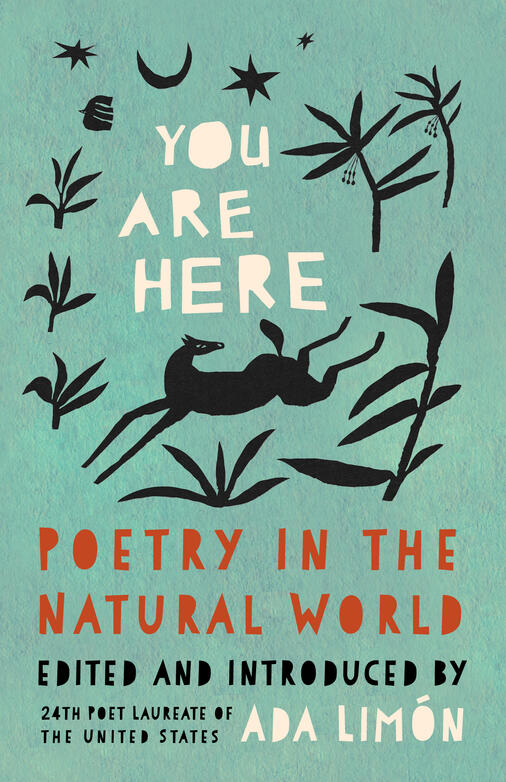
You Are Here
Published in association with the Library of Congress and edited by the twenty-fourth Poet Laureate of the United States, a singular collection of fifty poems reflecting on our relationship to the natural world by our most celebrated contemporary writers.
For many years, “nature poetry” has evoked images of Romantic poets standing on mountain tops. But our poetic landscape has changed dramatically, and so has our planet. Edited and introduced by the twenty-fourth Poet Laureate of the United States, Ada Limón, this book challenges what we think we know about “nature poetry,” illuminating the myriad ways our landscapes—both literal and literary—are changing.
You Are Here features fifty previously unpublished poems from some of the nation’s most accomplished poets, including Joy Harjo, Diane Seuss, Rigoberto González, Jericho Brown, Aimee Nezhukumatathil, Paul Tran, and more. Each poem engages with its author’s local landscape—be it the breathtaking variety of flora in a national park, or a lone tree flowering persistently by a bus stop—offering an intimate model of how we relate to the world around us and a beautifully diverse range of voices from across the United States.
Joyful and provocative, wondrous and urgent, this singular collection of poems offers a lyrical reimagining of what “nature” and “poetry” are today, inviting readers to experience both anew.